Pharmacy Operations, Dispensing & Medication Safety
The Pharmacy & Medication Safety module in MOANA manages the full pharmaceutical supply chain and clinical dispensing workflow. It ensures closed-loop medication management through four-stage clinical verification, mandatory two-pharmacist ("Four-Eyes") safety checks, dual-witness controlled drug ledgers, cold chain compliance, automated ward replenishment, and antimicrobial stewardship.
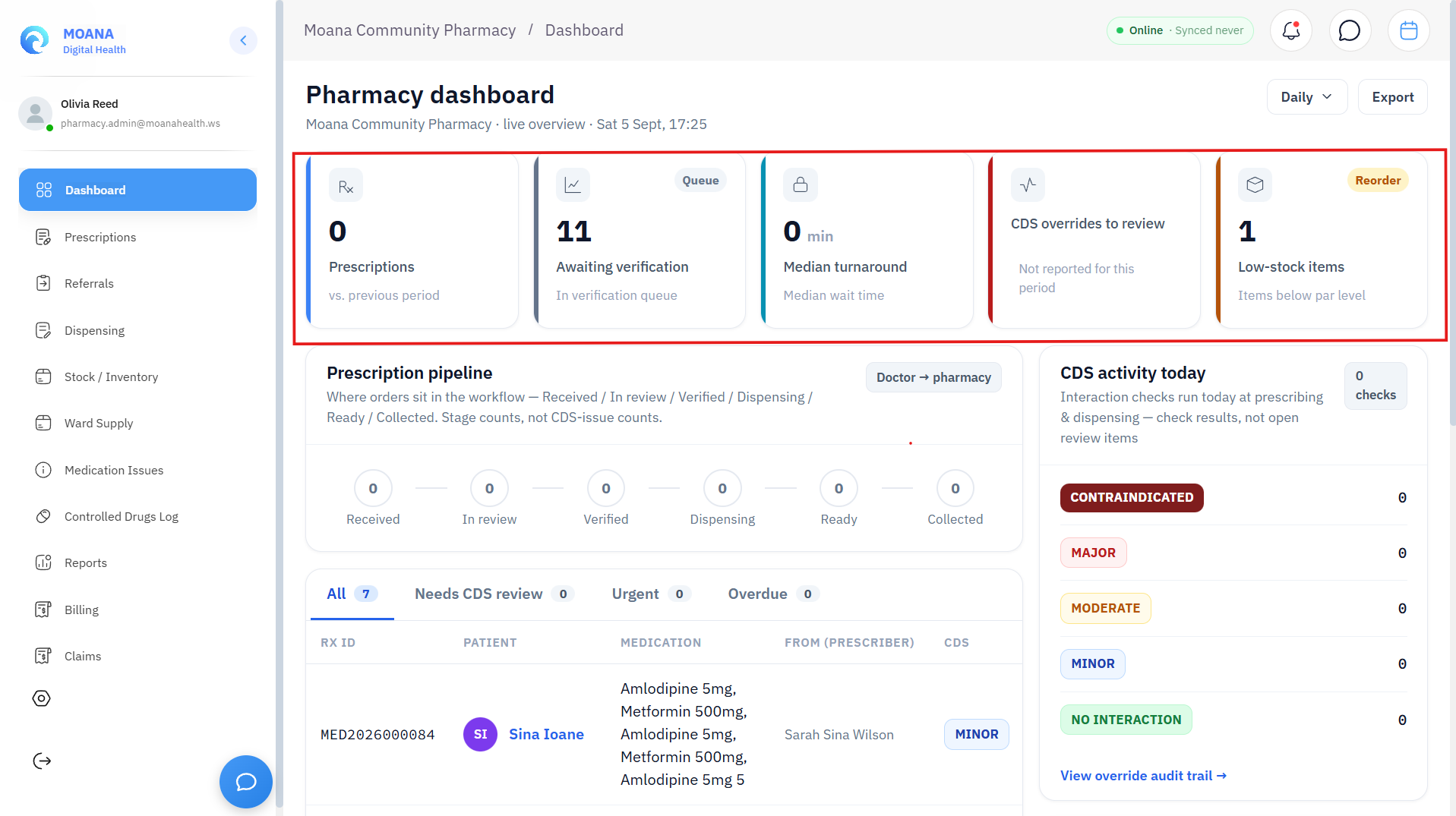
1. Safety Architecture & The Four-Stage Dispensing Lifecycle
To prevent medication errors, adverse drug events (ADEs), and unauthorized dispensing, MOANA implements a closed-loop four-stage lifecycle:
graph LR
    A[1. Doctor Signs Rx] --> B[2. Pharmacist: Clinical Verification]
    B --> C[3. Pharmacy Tech: Preparation & Scan]
    C --> D[4. Second Pharmacist: Four-Eyes Final Check]
    D --> E[5. Dispensed & Posted to Nursing eMAR]
Stage 1: Clinical Prescription Verification
- All newly authored electronic prescriptions arrive in the Dispensing Queue with status
Pending. - The verifying pharmacist confirms:
- Patient identification, age, weight, and renal/hepatic function.
- Drug molecule, dosage form, strength, dosing frequency, route, and duration.
- Clinical indication and appropriateness.
- Automated Clinical Decision Support (CDS) Screening:
- Drug-Allergy Evaluation: Checks documented patient allergies for cross-sensitivities.
- Drug-Drug Interactions: Evaluates active concurrent inpatient/outpatient medications.
- Therapeutic Duplications & Dose Limits: Flags duplicate therapies or doses exceeding maximum recommended limits.
- Enforced Safety Hard-Stop Gate:
- If an unacknowledged severe contraindication is detected, the system locks dispensing with a 403 Hard Stop.
- The pharmacist logs a Clinical Pharmacist Intervention and contacts the prescribing physician. Dispensing cannot proceed until the physician reviews, modifies, or formally overrides the alert.
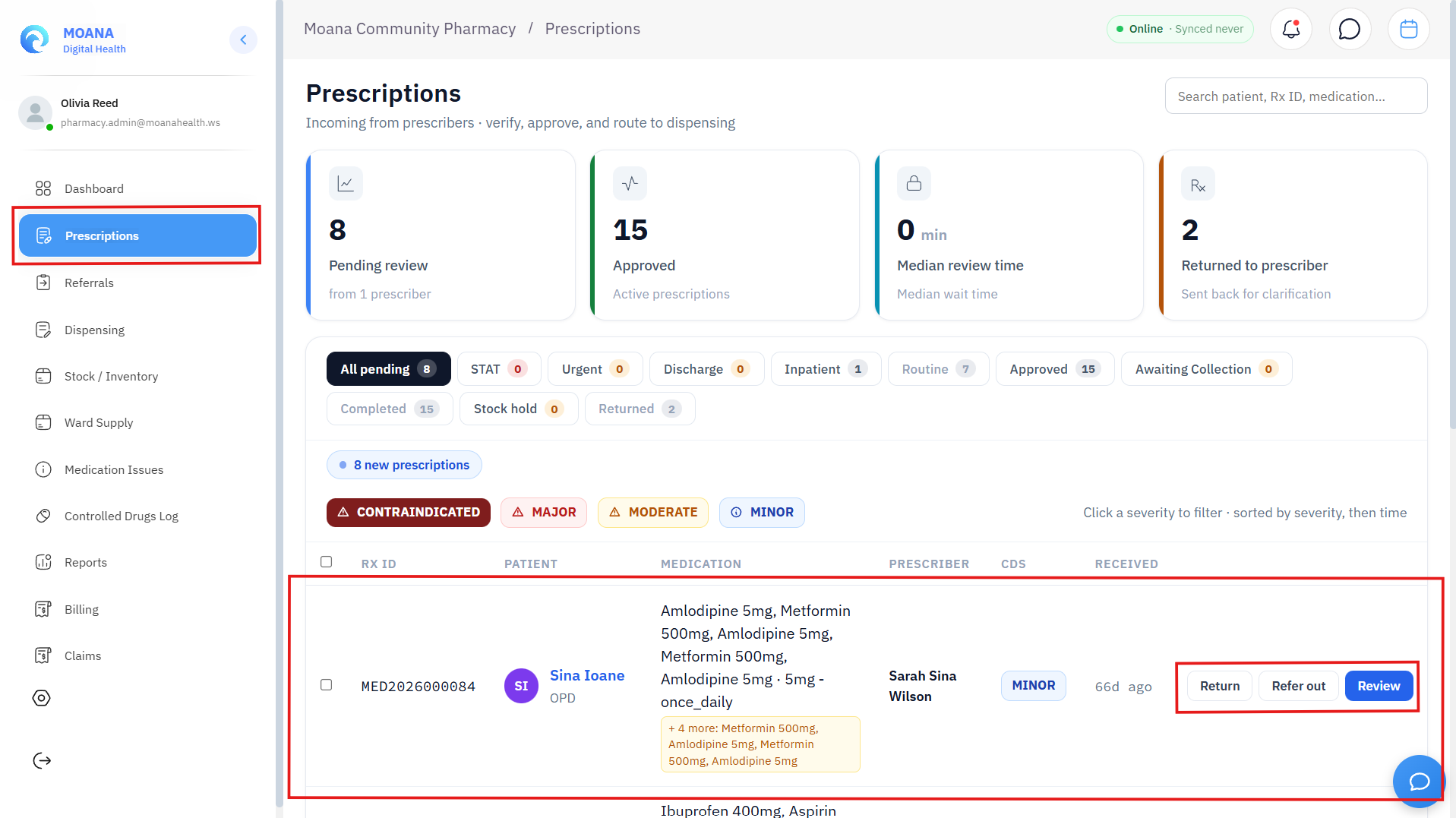
Stage 2: Medication Preparation & Barcode Verification
- The verified order moves to the Preparation Workbench.
- The pharmacy technician retrieves the medication from the designated bin/shelf.
- Scan-to-Verify: Scanning the medication manufacturer barcode or GS1 DataMatrix validates that the physical package matches the exact prescribed drug, strength, and formulation.
- Direction Label Generation: The system generates and prints standard pharmacy direction labels containing:
- Patient Full Name & MOANA Health ID.
- Prescribed Drug Name, Dose, and Route.
- Clear Administration Instructions (e.g., Take 1 tablet by mouth twice daily with meals).
- Expiry Date, Batch/Lot Number, and Storage Conditions (e.g., Refrigerate 2–8°C).
- Dispensing Date and Dispensing Pharmacy identifier.
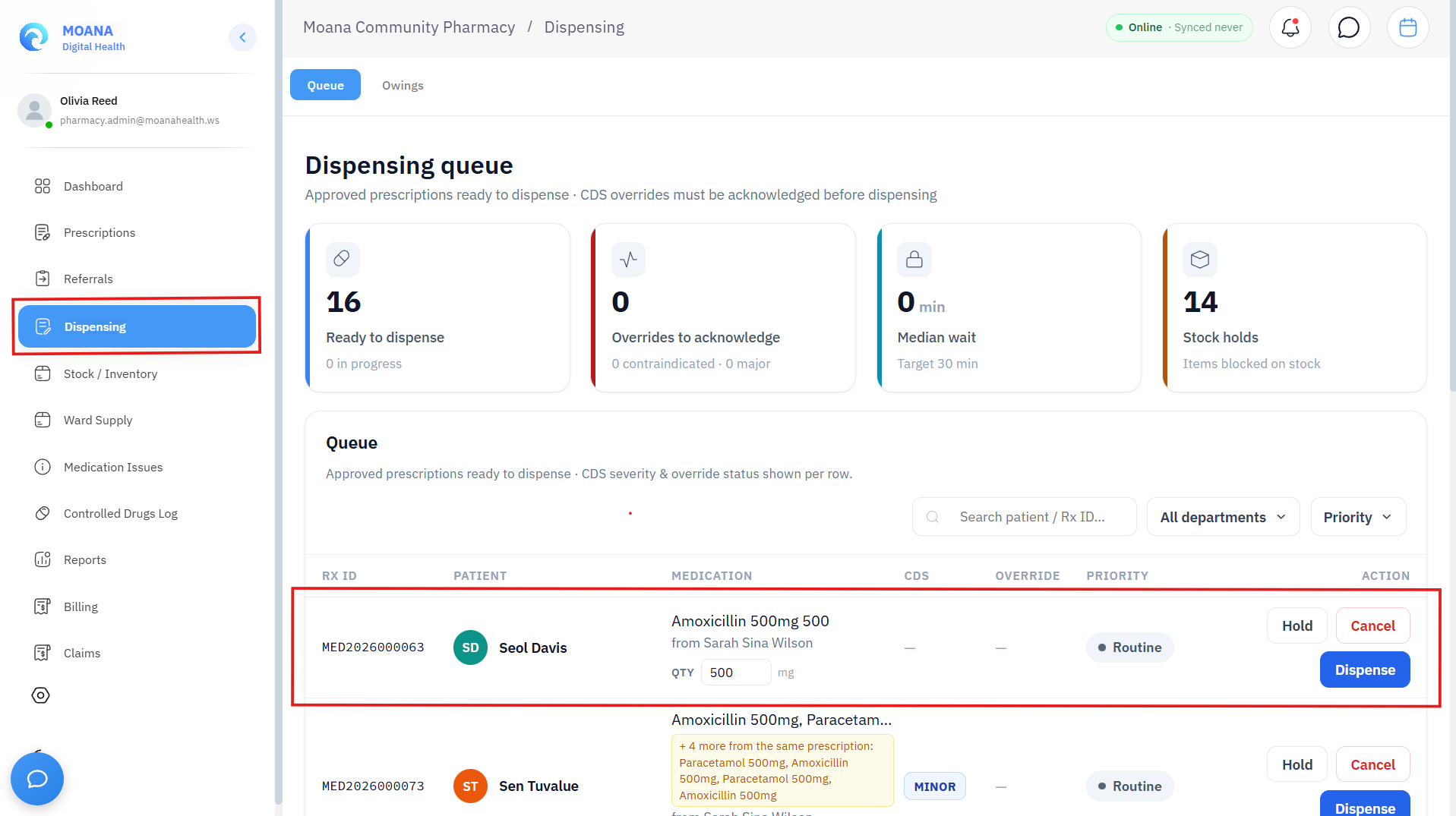
Stage 3: Independent Final Check (System-Enforced Four-Eyes Rule)
- A different qualified pharmacist opens the order for final verification.
- The checker performs an independent visual and electronic review of the physical medication against the original electronic prescription.
- Four-Eyes System Gate: The system strictly prevents the user who prepared the medication from completing the final check.
Stage 4: Dispensing, Patient Counseling & Automated Hand-offs
- The final checking pharmacist marks the order as
Dispensed. - Automated Cross-Module Hand-offs:
- Perpetual Stock Deduction: Pharmacy inventory levels decrement immediately in real time.
- Nursing eMAR Activation: For admitted inpatients, the medication appears instantly on the nursing Medication Administration Record (eMAR) with due times.
- Financial Posting: Billable medication charges automatically post to the patient's billing encounter.
- Patient Counseling & Owings:
- Conduct structured medication counseling for outpatients.
- If stock is insufficient for the full course, log an Owing Balance on the Owings Board so the remaining quantity can be collected upon restocking.
2. Controlled Drugs (Dangerous Drugs / Narcotics) Register
For Schedule II / Schedule 8 controlled substances (e.g., Morphine, Fentanyl, Oxycodone, Pethidine, Methadone, Midazolam), MOANA enforces a tamper-proof digital perpetual register:
graph TD
    A[Controlled Drug Request] --> B[Primary Pharmacist Authentication]
    B --> C[Secondary Witness Authentication Doctor/RN]
    C --> D[Cryptographic Verification Token Validated]
    D --> E[Perpetual Register Updated with Physical Balance]
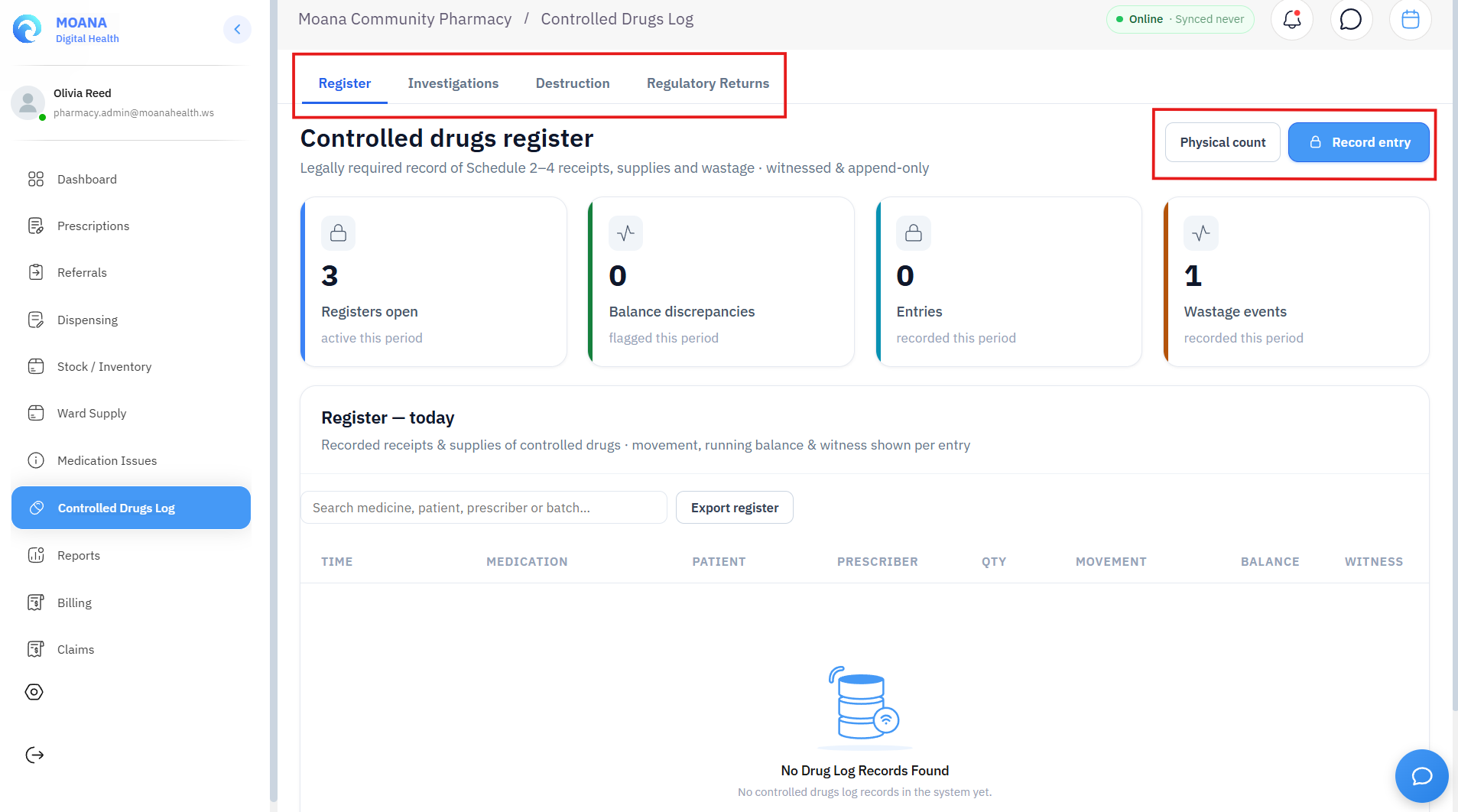
Key Controlled Drug Capabilities:
- Dual-Witness Authentication: Dispensing, receiving, or transferring controlled drugs requires simultaneous authentication by the primary pharmacist and an independent authorized witness (Doctor or Registered Nurse) using a secure 5-minute cryptographic token or PIN.
- Mandatory Balance Reconciliation: Before every transaction, the physical ampoule/tablet count must be verified against the registered digital balance.
- Discrepancy Investigation Workflow:
- Any variance between physical count and digital ledger immediately triggers an official Controlled Drug Investigation.
- The system locks the specific drug batch and requires a documented root cause and supervisor outcome report before the audit case can be resolved.
- Controlled Drug Destruction Protocol:
- Expired, damaged, or returned narcotics are placed into secure quarantine.
- Destruction requires two authorized senior witnesses, official destruction method logging, and automated generation of the regulatory Certificate of Destruction.
3. Stock Inventory, Expiry Tracking & Cold Chain Management
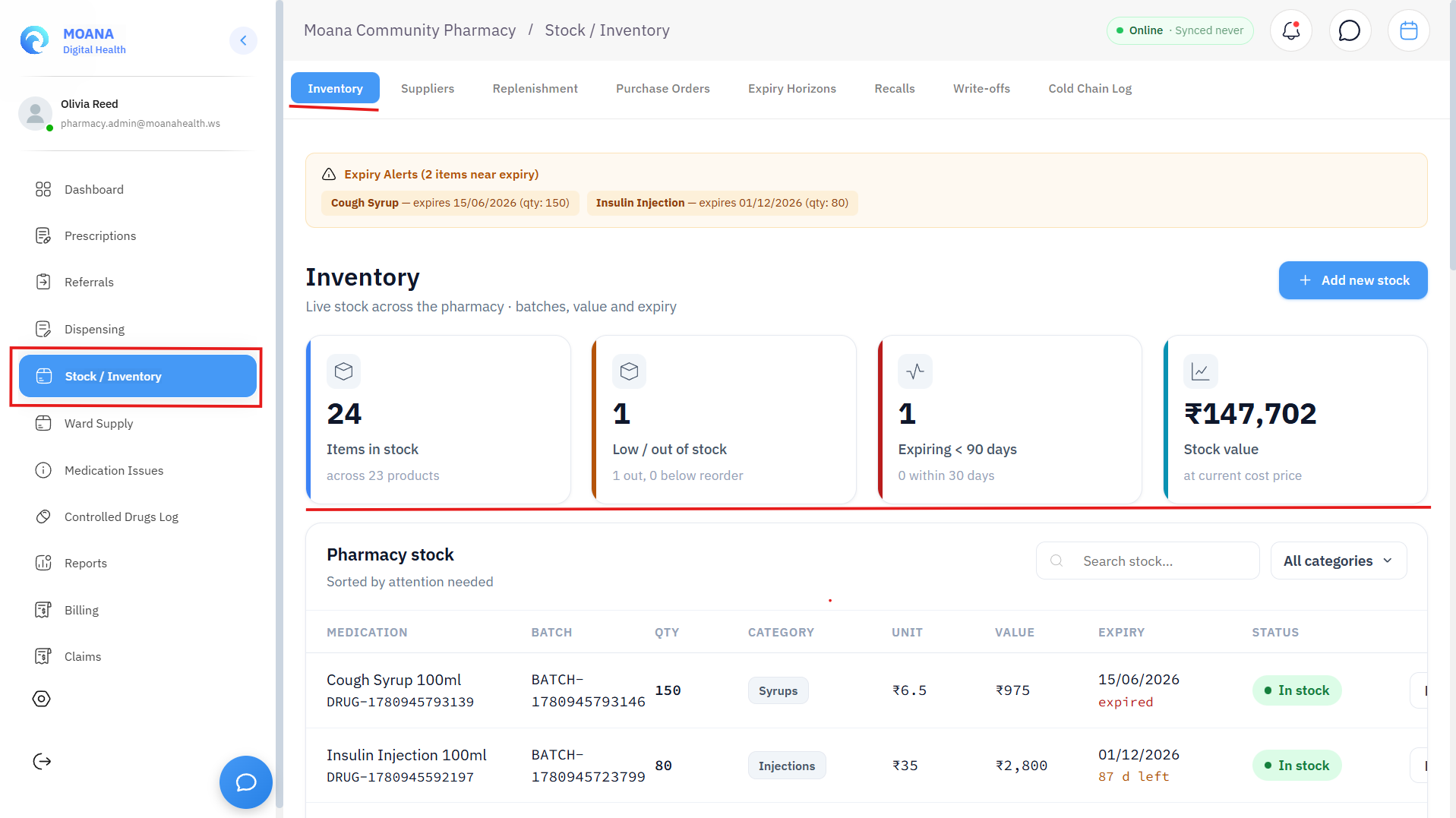
1. Multi-Tier Expiry Horizon Management
The inventory dashboard categorizes stock by expiry risk:
- 🔴 Critical (< 30 Days): High priority for immediate use, return to supplier, or inter-facility rebalancing.
- 🟠 Warning (30–90 Days): Flagged for FIFO (First In, First Out) dispensing prioritization.
- 🟡 Monitor (90–180 Days): Approaching mid-term horizon.
- 🟢 Stable (> 180 Days): Ample shelf life.
2. Cold Chain Logging & Temperature Excursion Monitoring
- Monitors medical refrigerators and vaccine storage units (2°C to 8°C) and ultra-low freezers (-20°C / -80°C).
- Logs twice-daily manual temperature checks or ingests continuous IoT temperature sensor telemetry.
- Any temperature excursion outside target parameters triggers automated alerts and prompts mandatory cold chain quarantine protocols.
3. Replenishment Workbench & Inpatient Ward Supply
- Ward Supply Requisitions: Inpatient wards submit daily stock top-up requests. The pharmacy workbench compiles pick-lists, verifies batch numbers, and issues transfers to ward drug rooms.
- Supplier Purchase Orders: Automated reorder recommendations based on historical consumption velocity, lead times, and minimum safety stock levels.
4. Clinical Pharmacy Services & Quality Assurance
1. Antimicrobial Stewardship (AMS)
- Tracks restricted broad-spectrum antimicrobials (e.g., Meropenem, Vancomycin, Colistin).
- Prompts mandatory 48–72 hour post-prescription reviews to encourage targeted de-escalation based on microbiology culture and sensitivity reports.
2. Clinical Interventions Dashboard
- Records pharmacist interventions (e.g., Dose optimization for renal impairment, Route conversion IV to Oral, Therapeutic drug monitoring - TDM).
- Tracks acceptance rates by prescribers to measure clinical pharmacy impact.
3. Medication Incident & Near-Miss Reporting (CAPA)
- Confidential reporting system for prescribing errors, dispensing near-misses, and packaging confusions.
- Integrates with Corrective and Preventive Action (CAPA) tracking to improve hospital safety protocols.
5. Pharmacy Role-Based Permissions Matrix
| Operational Capability | Pharmacy Tech | Staff Pharmacist | Senior Pharmacist | Pharmacy Director |
|---|---|---|---|---|
| Dispensing Queue: Preparation | ✅ | ✅ | ✅ | ✅ |
| Dispensing Queue: Clinical Verification | ❌ | ✅ | ✅ | ✅ |
| Dispensing Queue: Final 4-Eyes Check | ❌ | ✅ | ✅ | ✅ |
| Dispense Controlled Drugs | ❌ | ⚠️ (Requires Witness) | ✅ (Requires Witness) | ✅ |
| Close CD Discrepancy Investigation | ❌ | ❌ | ❌ | ✅ |
| Approve Stock Write-offs & Destruction | ❌ | ❌ | ✅ | ✅ |
| Modify Master Drug Formulary & Tariffs | ❌ | ❌ | ❌ | ✅ |